


How Agentic AI transforms the SDLC: From smart tools to coordinated systems of agents

Felipe Cauê Fraga Carneiro • February 2, 2026

Agentic AI is quickly becoming the next buzzword in software engineering, but most teams still live in a world of chatbots and isolated AI helpers.


To understand what really changes with agentic AI, it helps to distinguish three layers of sophistication: chats, agents, and systems of agents, and then imagine what happens when we apply them across the entire software development life cycle (SDLC).

From chats to agents to systems of agents

What is a chat?


A chat interface (like a typical LLM chatbot) is a powerful question–answer machine.
You ask: “I’m traveling to Washington in December, what should I know?”

The model looks at your prompt, predicts a good answer based on its training data, and returns a single response. The interaction is basically:


Input → One-shot reasoning → Ouput


When you need something more, you are the orchestrator: you refine the prompt, open another tool to check prices, copy and paste results, and so on.


What is an agent?


An agent is different because it doesn’t stop at one-shot reasoning. It operates in a loop:


Observe → Plan → Act → Observe again → Adjust


If you give an agent the same travel question, it might:


  1. Check the weather forecast for São Paulo in December.

  2. Call an API to search for flights and hotels within your budget.

  3. Look up attractions aligned with your profile.

  4. Combine all that into an itinerary, adjusting as it discovers new constraints.


Instead of just answering, the agent works on your behalf, calling tools, using APIs, and iterating until it reaches a satisfactory outcome.


What is a system of agents?


Now imagine not a single agent, but a system of specialized agents collaborating.


Think of a restaurant:


  • With one agent, the same person takes orders, cooks, serves, and washes dishes. It works on a quiet night, but it doesn’t scale.

  • In a system of agents, roles are specialized: a waiter, a chef, a dishwasher, a cashier—each “agent” has its own job. Coordination ensures the whole restaurant works smoothly.


In an AI context, a system of agents combines multiple specialized agents - planning, coding, testing, monitoring - coordinated by an orchestration layer that routes tasks, shares context, and keeps the loop running until a higher-level goal is done.

That’s exactly the transition we are starting to see in software development.


Mapping agentic AI to the SDLC

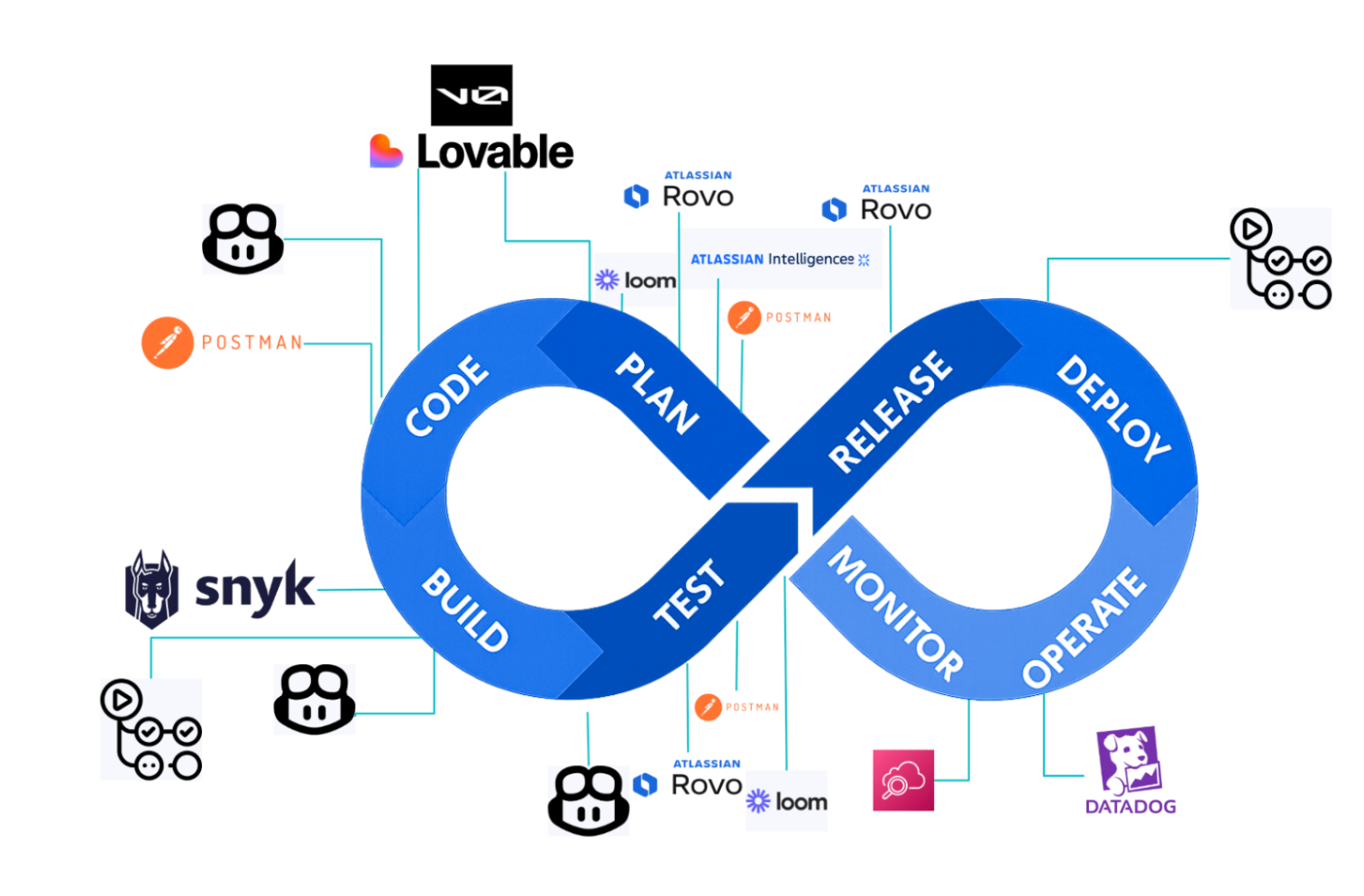
The classic SDLC infinity loop includes stages like Plan, Code, Build, Test, Release, Deploy, Operate, Monitor, then back to planning again.


Today, many teams already use AI-powered tools at each phase:


  • Plan: assistants embedded in tools like Confluence or Rovo help refine user stories and check whether they follow SMART criteria (Specific, Measurable, Achievable, Relevant, Time-bound). They can even draft the stories themselves.

  • Design and prototyping: tools like Lovable or v0 generate UI prototypes, flows, and initial templates from natural language descriptions.

  • Code and build: code assistants help implement stories, connect to systems like Jira to pull context, and even trigger builds. Security tools like Snyk scan for vulnerabilities.

  • Test: AI test generators create unit tests, integration tests, and API tests. Postman and similar tools can record flows and turn them into reusable automated suites.

  • Release and deploy: AI can help compose release notes, summarize changes, and support CI/CD decisions.

  • Operate and monitor: platforms like Datadog increasingly embed AI to detect anomalies, correlate signals, and generate human-readable incident summaries.

If you look at the image of the SDLC loop with these tools connected, each logo is essentially a specialized agent supporting one task in the software factory.


But here’s the key point: this is still not an agentic SDLC system.


Why this isn’t agentic AI yet


In most organizations today, humans still play the role of “head chef and restaurant manager”:


  • A product owner writes or approves the story.

  • A designer manually passes context into a prototyping tool.

  • A developer copies Jira story IDs into their IDE or AI code assistant.

  • A QA engineer configures the AI test generator.

  • An SRE watches monitoring dashboards and manually opens incident tickets.


The tools are clever, but they don’t coordinate with each other on their own. The workflow is fragmented; people shuttle context and decisions from one tool to the next.


So what would change if we truly had an agentic system around the SDLC, rather than a collection of smart tools?

What an agentic SDLC system could look like


Imagine a future sprint in an agentic SDLC.


1. From business goal to refined user story


A product manager states a goal in natural language:

“We need customers to filter products by price range and category.”


A Planning Agent:


  • Validates whether this story is SMART.

  • Clarifies missing details by asking targeted questions.

  • Splits the requirement into smaller, deliverable user stories.

  • Stores them in the work management tool, with acceptance criteria attached.

2. Automatic design and prototyping


Once a story is ready, a Design Agent is automatically triggered:


  • Generates UI mockups and flows using a prototyping tool.

  • Aligns them with existing design systems.

  • Attaches prototypes back to the story for review.


If business rules change, the planning and design agents re-sync automatically.


3. From story to code


When the story is approved, a Development Agent takes over:


  • Pulls the story details and prototypes.

  • Uses a code assistant plus context from the repository to generate an initial implementation.

  • Spins up tests alongside the code (for example, unit tests based on the acceptance criteria).

  • Opens a pull request, with a summary of what was implemented and why.

A Security Agent runs tools like Snyk on the branch, commenting on the PR if it detects vulnerabilities and proposing fixes.


4. Testing and quality gates


A Testing Agent orchestrates:


  • Generation of additional tests (integration, API, end-to-end) using tools like Postman.

  • Execution of the full suite in CI.

  • Aggregation of results into a single quality report, mapped to the original story.

If tests fail, the agent loops back: it either attempts a fix directly (for smaller issues) or annotates the PR with suggested changes.


5. Release, deploy, and communicate


Once quality gates pass, a Release Agent:


  • Groups stories into releases.

  • Drafts concise release notes automatically.

  • Coordinates with a Deployment Agent that triggers the appropriate pipeline and rollout strategy.


Post-deployment, the Release Agent keeps track of rollout progress and rollback options, again without manual glue work.


6. Monitoring and self-healing


In production, a Monitoring Agent continuously watches metrics and logs:


  • When an anomaly appears, it correlates signals with recent changes.

  • It automatically opens an incident ticket, attaches a suspected root cause, and suggests potential fixes referencing the relevant code files.

  • For low-risk, well-understood issues, it could even propose or apply a patch, then run tests and, if successful, deploy the fix.


In this vision, the infinity loop closes itself. The system of agents collaborates to move work from idea to production and back to learning with minimal human orchestration.


Engineers still play a crucial role, but more as supervisors, decision-makers, and designers of the workflow, rather than manual integrators between tools.


Why so few companies are here yet

Very few organizations have reached this level of agentic maturity today. That’s not due to lack of tools, but because building a system of agents for the SDLC requires several ingredients:


  1. Deep understanding of the current process
    You need to know where the real bottlenecks are, test execution, triage, monitoring, story refinement, before deciding where agents will add the most value.

  2. Clear, consistent workflows
    If your SDLC is chaotic and undocumented, it’s difficult for agents to reason about handoffs and success criteria.

  3. An orchestration layer
    Specialized agents must be able to call each other, share state, and work with the same context. That often requires:

  • A platform (commercial or internal) acting as the “conductor”.

  • Integrations with tools like work tracking, source control, CI/CD, observability, and knowledge bases.

  1. Engineering skills for integration
    Beyond prompt engineering, teams need people who understand:

  • APIs and webhooks for SDLC tools.

  • Security and compliance constraints.

  • How to design robust agent workflows and guardrails.

  1. A new kind of role: the AI/DevEx engineer or AI process consultant
    This person (or team) sits at the intersection of business, process, and engineering:

  • Understands the client or internal team’s way of building software.

  • Identifies where agents can automate or augment work.

  • Chooses the right tools and stitches them together into a coherent system.

  • Measures the impact and iterates.


Because this combination of process knowledge, technical integration, and AI design is rare, and platforms are still maturing, most companies are still in the “many smart tools, little orchestration” stage.


How to start moving toward an agentic SDLC

You don’t need to jump straight to a fully autonomous system. A pragmatic path looks like this:


  1. Pick one high-impact loop, not the whole SDLC
    For example:

  • From monitoring alert → incident ticket → suggested root cause.

  • From business requirement → SMART story → initial prototype.

  • From merged PR → generated tests → release notes.

  1. Treat each tool as a potential agent
    Start from the SDLC image: each logo can be seen as an agent specializing in a particular capability. Ask:
    What information does it need? What can it produce? Who should consume that next?

  2. Add an orchestration brain
    Use an agent framework or integration platform to route tasks between tools. Even a relatively simple orchestrator can:

  • Watch for events (new tickets, alerts, PRs).

  • Call the right AI tool or model.

  • Feed results into the next tool automatically.

  1. Create a small “agentic SWAT team”
    Assemble a group with:

  • Process owners (who understand how work actually flows).

  • Engineers (who know the tools and APIs).

  • AI specialists (who design prompts, guardrails, and evaluation).

Measure, learn, and expand
Track lead time, incident resolution time, number of manual handoffs, and developer satisfaction. Once one loop works reliably, extend the same patterns across other stages of the SDLC.


Conclusion: from isolated helpers to coordinated agents


Agentic AI in software development is not just “smarter autocomplete”. It’s a shift from:


  • Chats that answer questions,

  • To agents that take actions in a loop,

  • To systems of agents that coordinate across the entire SDLC.


The tools already exist in almost every stage of the infinity loop. The real opportunity, and challenge, is to connect them into coherent, goal-driven systems that can move work forward with minimal friction.


Most organizations are still early in this journey, but teams that invest now in understanding their processes, building orchestration layers, and cultivating hybrid business, engineering AI roles will be the first to operate true agentic SDLC systems.


And when that happens, “shipping software” will feel less like manually pushing work around a board, and more like supervising a team of tireless, well-coordinated digital colleagues.

Blue logo with a teal person figure and upward arrows, beside the text

e-Core

We combine global expertise with emerging technologies to help companies like yours create innovative digital products, modernize technology platforms, and improve efficiency in digital operations.


You may also be interested in:

By Elias Brito January 12, 2026
Learn how agile for data teams enables predictable AI delivery by aligning experimentation, governance, MLOps, and business outcomes.
By Danilo Gomes January 9, 2026
Discover the most common cloud migration security concerns and learn how modern cloud platforms address data control, IAM, compliance, and migration risks.
By Danilo Gomes January 9, 2026
Discover four key reasons why 2026 is the ideal year to migrate from Atlassian Data Center to Cloud and how to prepare your organization for the transition.