


SLA Automation in Jira: streamline for greater efficiency and accountability

e-Core • September 5, 2025

In an era where time is synonymous with currency, prompt resolution of customer issues is not just a service goal—it's a competitive necessity. From this perspective, SLA automation represents a revolution, transforming potential service pitfalls into opportunities to demonstrate reliability and efficiency.


The crucial role of SLAs in customer satisfaction


Service Level Agreements (SLAs) are not merely contractual obligations; they are pledges of reliability and trust between service providers and their clients. As businesses grow and operations become more complex, managing these agreements manually becomes a daunting and error-prone task. SLA Automation within Jira Service Management provides a systematic and fail-proof approach to managing these crucial agreements, ensuring that service providers meet their contractual promises efficiently.


Why SLA Automation is a strategic asset 


Many service management professionals identify manual SLA tracking as a major obstacle in fulfilling service commitments. Surveys and reports from industry groups highlight the challenges and inefficiencies associated with traditional methods of managing service-level agreements. Jira's dynamic capabilities for automating SLA tracking can turn this challenge into a strategic advantage by providing real-time visibility and proactive management of service commitments.

The customization of automation rules to align precisely with diverse SLA metrics—such as response times, resolution times, and uptime guarantees—requires meticulous configuration. Incorrect setups can lead to premature or delayed actions, potentially breaching the SLA and eroding client trust.

Studies in the field of service management suggest that implementing automation can
significantly reduce human errors in SLA management, while also improving compliance rates dramatically. These findings reflect the broader consensus on the benefits of automating complex and repetitive tasks.


SLA Automation Rule: an illustrative example in Jira


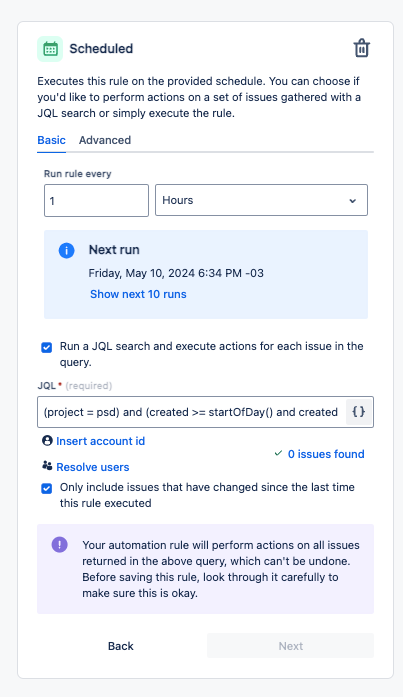
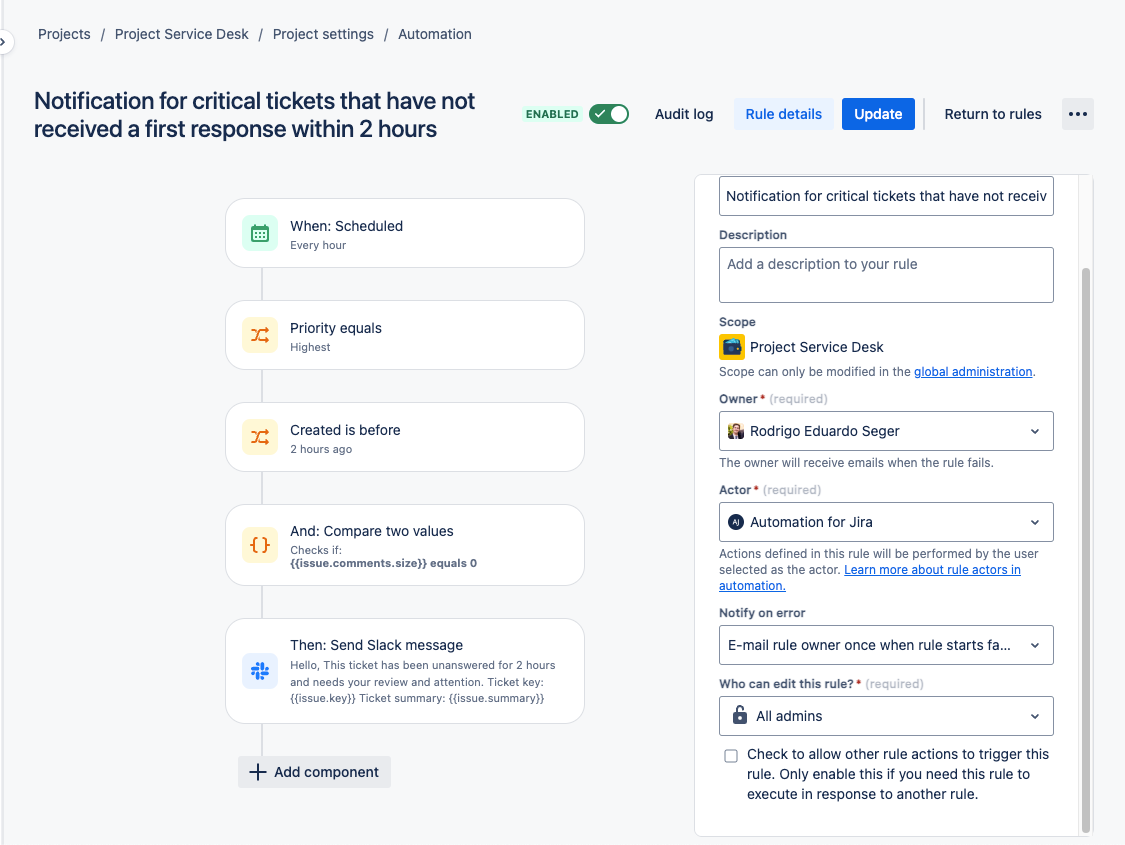
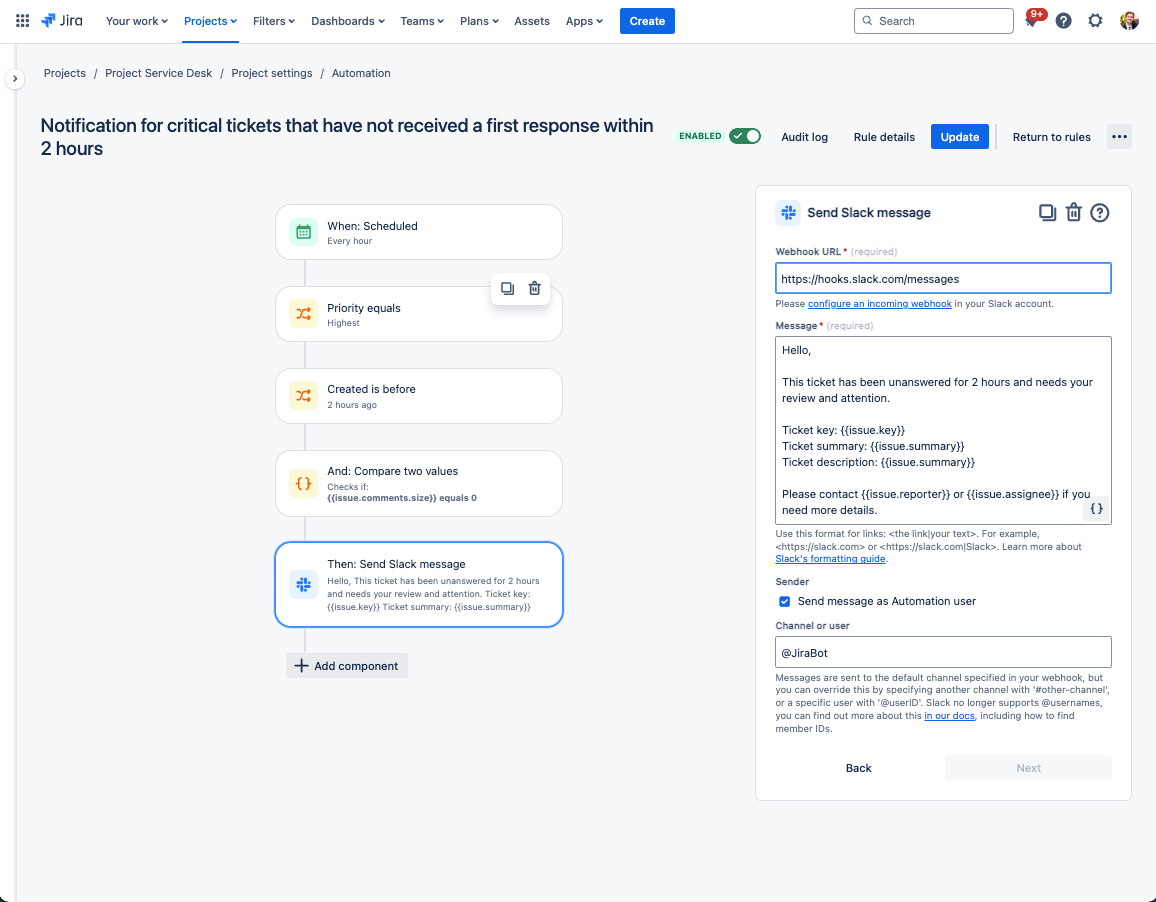
To illustrate the advantages of an SLA automation strategy within Jira Service Management, we’ve provided the example below:

  • Trigger: Creation of a ticket labeled 'Critical'.
  • Condition: 2 hours pass without a first response.
  • Action: The ticket is automatically escalated to a higher-tier support team, and an urgent notification is sent to the department manager.


vLink for automation rule file: https://drive.google.com/file/d/19YBSed2ddhUw-8YJmAH30Lbsl0ivVmEs/view?usp=sharing

This automation leverages Jira’s built-in time-tracking capabilities to monitor the elapsed time from ticket creation. If the response time approaches the SLA limit, the automation triggers predefined escalation protocols, ensuring that critical issues are addressed promptly and effectively, thus adhering to the SLA.

Automating SLA management within Jira does more than
streamline operations; it redefines the benchmarks for reliability and customer service. This proactive approach not only minimizes SLA breaches but also enhances transparency with clients, illustrating a commitment to service excellence.

Step into the future of service management by implementing SLA automation in your Jira setup today. Begin with a pilot project to gauge the impact on your service delivery and client satisfaction, and gradually expand automation across all service areas.


References for Further Reading:


  1. A. Schmietendorf, R. Dumke and D. Reitz, "SLA management - challenges in the context of Web-service-based infrastructures," Proceedings. IEEE International Conference on Web Services, 2004., San Diego, CA, USA, 2004, pp. 606-613, doi: 10.1109/ICWS.2004.1314788. keywords: {Web services;Context-aware services;Technology management;Business;Quality of service;Monitoring;Cost function;Current measurement;Pressure measurement;Web and internet services}, link to access: https://ieeexplore.ieee.org/abstract/document/1314788

  2. Chau, Tony et al. (2008). "Automating SLA modeling." Proceedings of the 2008 Conference of the Center for Advanced Studies on Collaborative Research: Meeting of Minds. New York, NY, USA: Association for Computing Machinery. DOI: 10.1145/1463788.1463802. Available at: https://doi.org/10.1145/1463788.1463802.


Tags: #JiraServiceManagement #Jira #JSM #SLA #Automation #SLAManagement


e-Core

We combine global expertise with emerging technologies to help companies like yours create innovative digital products, modernize technology platforms, and improve efficiency in digital operations.


You may also be interested in:

July 23, 2026
See how Banco Inter migrated to Jira Cloud, cut $200K in annual costs, and boosted team efficiency with e-Core as its implementation partner.

By Flávia Batista July 10, 2026
There is a belief that runs deep inside IT operations teams: a noisy environment is a healthy one. If alerts are firing constantly, if tickets are piling up, if the on-call rotation is getting hit at 2am, that means monitoring is working. The tools are catching things. I understand where this comes from. In the early days of observability, silence was genuinely suspicious. A quiet dashboard often meant a gap in coverage, a misconfigured rule, something important slipping through undetected. So teams learned to treat volume as proof, and that instinct stayed long after the environment around it changed. But noise is not proof that monitoring is working. In most cases, it is proof that something upstream was never fixed. Automation at the wrong end When alert volume becomes unsustainable, the response is almost always the same. Leadership looks at the backlog (a thousand tickets a day, engineers buried, SLAs slipping) and reaches for automation at the remediation end of the pipeline: AI agents plugged into monitoring tools, scripts that fire when incident X arrives, routing logic that moves tickets faster. These are reasonable responses to an unreasonable situation, but they treat cost rather than cause. Most of those alerts should never have been generated. Processing them faster does not change why they exist.

By Adriele Radmann June 22, 2026
Senior engineers lose 30% of their time to operational overhead. Discover how Agentic AI reclaims their cognitive bandwidth and prevents burnout-driven attrition.