


Navigating change management to ensure a successful transition to cloud

Filipe Barretto • June 15, 2023

“There is nothing called a ‘safe comfort zone’. This is a convenient name depicting the process of degeneration.” I really like this quote by author Manoj Arora because it serves as a reminder that if we don’t constantly reinvent ourselves and innovate, we will be left behind. This principle applies to companies’ adoption of cloud technology.


This is because, invariably, using cloud computing technologies and following best practices will bring about several changes that impact organizations, ranging from financial aspects (such as the pay-as-you-go model) to technical aspects (such as learning more about new tools).


All these challenges have something in common, which is precisely the key to success in this journey: people. For cloud adoption to be successful, people need to change the way they interact with technology, and they need to receive the necessary support for that to work.


Kübler-Ross curve and emotional responses to change

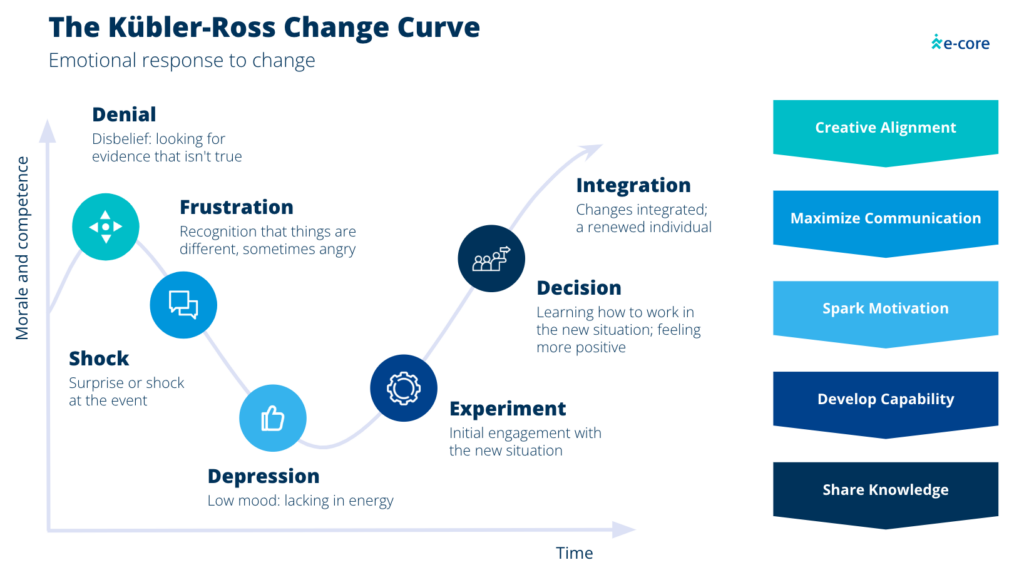
The process of accepting change involves several emotional responses, as illustrated by the Kübler-Ross Change Curve. It comes as no surprise that the initial responses are negative: shock, denial, frustration, and depression.


To the right side of the image, there are some strategies for dealing with emotional responses at each stage of the curve listed. To get through the initial stages quickly, for example, some of the important items are clear communication of the benefits people will have with the change and how they will receive support in developing the skills necessary to deal with new requirements.


How does this apply to the cloud journey?

In the context of a cloud journey, this process consists of developing a clear strategy and an action plan that involves the entire enterprise.


As highlighted by Adrian Cockcroft, VP of Cloud Architecture Strategy at AWS, in the foreword to the book Ahead in the Cloud, transitioning to the cloud requires an understanding of DevOps, but DevOps usually means reorganizing, not renaming a team.


At e-Core, we use the AWS Cloud Adoption Framework (CAF) and the Google Cloud Adoption Framework in our projects.


The AWS Cloud Adoption Framework (CAF) supports companies in structuring their journey across six perspectives: business, people, governance, platform, operations, and security.

By following the framework, it is possible to conduct a diagnosis of the company’s current state and its strengths and weaknesses in relation to Cloud Computing best practices. Based on this information, an action plan is created.


Beyond an action plan, the most important benefit of CAF is to change the mindset of professionals.


From the onset, professionals learn in a structured way what a cloud journey looks like, rather than relying on Internet tutorials that don’t necessarily follow best practices. Moreover, they start understanding how their careers will benefit from the cloud, that learning is not as difficult as it seems, and that there is a clear progression plan.


The Google Cloud Adoption Framework helps businesses identify key activities and objectives that will reliably accelerate their cloud journey. It focuses on four realms: lead, learn, scale and secure.


By applying the framework, it is possible to learn about the capabilities your organization needs to cultivate successful cloud adoption and use a Cloud Maturity Assessment to learn where you are in your cloud journey and what steps you should take to move forward.


Change as a collective construction

Unfortunately, in a hurry to start the project quickly, many companies end up skipping this initial step. What we often see is a forced, top-down change, with only general guidelines and the expectation that professionals will figure out on their own how to handle the new routines through documentation they find on the web. This has its price.


I have worked on a few projects where companies preferred to focus on initial alignment and planning to see the actual benefits later on. The difference is clear.


When we started a project in one of the largest gym chains in Brazil, the initial workshop was attended by the CEO, CTO, CFO, Legal Director, HR Director, and other company leaders.


Hence, everyone brought their concerns to the table, enabling the preparation of a structured action plan, which also involved training the professionals.


We had a similar approach at one of the largest logistics operators in Brazil, enabling a strategic alignment of the entire organization. In addition to having all professionals on the same page, it made them focus on self-study and training to bring faster gains.


This structured approach to the change process is what makes the biggest difference in a journey to the cloud. After all, for any challenge we have, the most critical factor for success and failure always comes down to people.


Learn how e-Core can help your business on the cloud journey


Related post: What to look for in a Cloud App Modernization Partner


Filipe Barretto

Cloud Sales Leader at e-Core

LET'S CONNECT

Ready to unlock your team's potential?


e-Core

We combine global expertise with emerging technologies to help companies like yours create innovative digital products, modernize technology platforms, and improve efficiency in digital operations.


You may also be interested in:

23 de julho de 2026
See how Banco Inter migrated to Jira Cloud, cut $200K in annual costs, and boosted team efficiency with e-Core as its implementation partner.

Por Flávia Batista 10 de julho de 2026
There is a belief that runs deep inside IT operations teams: a noisy environment is a healthy one. If alerts are firing constantly, if tickets are piling up, if the on-call rotation is getting hit at 2am, that means monitoring is working. The tools are catching things. I understand where this comes from. In the early days of observability, silence was genuinely suspicious. A quiet dashboard often meant a gap in coverage, a misconfigured rule, something important slipping through undetected. So teams learned to treat volume as proof, and that instinct stayed long after the environment around it changed. But noise is not proof that monitoring is working. In most cases, it is proof that something upstream was never fixed. Automation at the wrong end When alert volume becomes unsustainable, the response is almost always the same. Leadership looks at the backlog (a thousand tickets a day, engineers buried, SLAs slipping) and reaches for automation at the remediation end of the pipeline: AI agents plugged into monitoring tools, scripts that fire when incident X arrives, routing logic that moves tickets faster. These are reasonable responses to an unreasonable situation, but they treat cost rather than cause. Most of those alerts should never have been generated. Processing them faster does not change why they exist.

Por Adriele Radmann 22 de junho de 2026
Senior engineers lose 30% of their time to operational overhead. Discover how Agentic AI reclaims their cognitive bandwidth and prevents burnout-driven attrition.