
Remote or in-person work? Meet our hybrid model

e-Core • August 13, 2021

It’s true that the world changed with the pandemic. We had to reinvent ourselves, especially in terms of the work model.


In a few months, drastic changes made us reflect on the prospects of distributed teams, as well as remote and asynchronous work.


Keep reading the blog to learn more about the work model we adopted and the 5 principles that make up our Future of Work Manifesto.


So, remote or in-person work?


The answer for us is hybrid work.


For us, choosing a hybrid model means we have the flexibility to adapt to the needs of our customers and the characteristics of different teams.


Our CEO, Marcio Silveira, commented on the made decision:

“As the environment around us changes more and more, our ability to adapt will be put to the test. We need to embrace innovation and continue our journey as lifelong learners. […] In a heterogeneous company like ours, we will pursue a combination of remote and in-person work models.”

What are the office+ and Remote+ models?


Office+ and Remote+ are the two possible work models to which employees will be assigned.


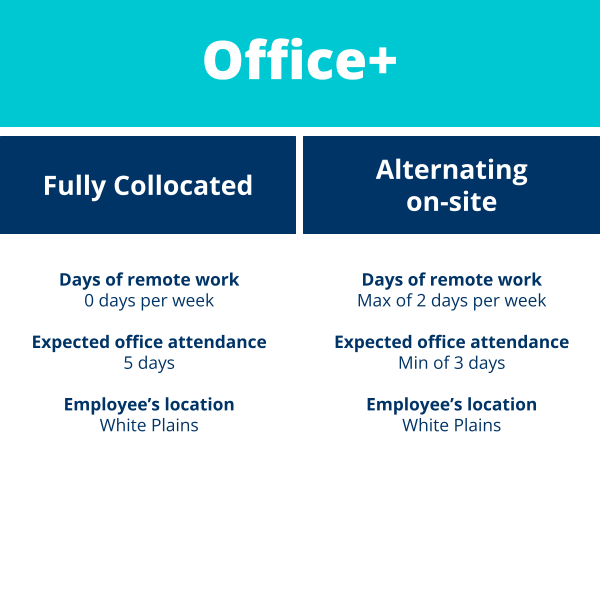
The Office+ model consists of the categories Fully Collocated and Alternating On-Site.


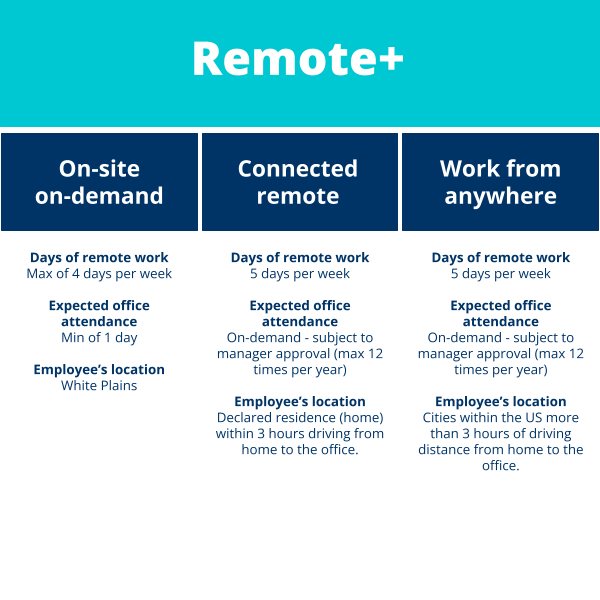
The Remote+ model consists of the categories On-Site On-DemandConnected Remote, and Work from Anywhere.


Check out the images below to learn all the details of each model:

Office+ and Remote+ employees


In stark contrast to before the pandemic, when working from home was sporadic for the most part of employees, our team is structured as follows:


  • Office+: 7% of employees will follow this model, including 1% in the Fully Collocated category and 6% in the Alternating On-Site category;


  • Remote+: 93% of employees will follow this model, including 20% in the On-Site On-Demand category, 57% in the Connected Remote category, and 16% in the Work from Anywhere category.


Future of Work Manifesto


To protect our values and our culture, as well as to maintain high levels of performance and trust among e-Coreans in a hybrid work environment, we follow five principles that make up our Future of Work Manifesto:


Hybrid and adaptable


Adopting hybrid work models means having the flexibility to adapt to remote or in-person work based on the context and needs of each team.


Strong culture everywhere


No matter where our team members are, we believe that employees and customers need to live and breathe our culture.

We rely on good management practices, genuine values, procedures, and cutting-edge tools to build a strong culture everywhere.


Equal opportunities for everyone


We understand that working remotely or in person doesn’t make anyone better or in a position to deliver more.


We have the mindset and the culture to promote fair treatment at work. Here, opportunities will not be restricted to those who work in our offices.


Work-life balance


We are a team that seeks to find a balance between professional and personal life, maintaining high levels of productivity.


We’re also aware of how we can help our colleagues have the same balance and productivity on a daily basis.


Asynchronous communication


It’s true that communication is becoming increasingly asynchronous in remote work environments.


Although it comes with greater flexibility, fewer interruptions, and higher productivity, we realize there are potential difficulties and take care to minimize them.


Do you have new plans for your career?


We don’t plan to change our values or our culture, but we are renewing our company practices to keep building a better future for our customers, employees, and business partners.


Take a look at the incredible opportunities available to work at e-Core!


LET'S CONNECT

Ready to unlock your team's potential?


e-Core

We combine global expertise with emerging technologies to help companies like yours create innovative digital products, modernize technology platforms, and improve efficiency in digital operations.


You may also be interested in:

Por Adriele Radmann 3 de agosto de 2026
Discover why customer support is your strongest shield against churn. Learn how to connect support, product dev, and AI to protect recurring revenue.
23 de julho de 2026
See how Banco Inter migrated to Jira Cloud, cut $200K in annual costs, and boosted team efficiency with e-Core as its implementation partner.

Por Flávia Batista 10 de julho de 2026
There is a belief that runs deep inside IT operations teams: a noisy environment is a healthy one. If alerts are firing constantly, if tickets are piling up, if the on-call rotation is getting hit at 2am, that means monitoring is working. The tools are catching things. I understand where this comes from. In the early days of observability, silence was genuinely suspicious. A quiet dashboard often meant a gap in coverage, a misconfigured rule, something important slipping through undetected. So teams learned to treat volume as proof, and that instinct stayed long after the environment around it changed. But noise is not proof that monitoring is working. In most cases, it is proof that something upstream was never fixed. Automation at the wrong end When alert volume becomes unsustainable, the response is almost always the same. Leadership looks at the backlog (a thousand tickets a day, engineers buried, SLAs slipping) and reaches for automation at the remediation end of the pipeline: AI agents plugged into monitoring tools, scripts that fire when incident X arrives, routing logic that moves tickets faster. These are reasonable responses to an unreasonable situation, but they treat cost rather than cause. Most of those alerts should never have been generated. Processing them faster does not change why they exist.