An unexpected gain of Agentic AI: retaining senior engineers

Adriele Radmann • June 22, 2026


An unexpected gain of Agentic AI: retaining senior engineers


The senior support engineer is the specialist in the bread line. They are the people with the skills to handle the most technically complex cases, the ones no one has seen before.


When a system failure occurs that stumps the rest of the organization, these engineers are the ones who step in to find the root cause.

However, we are seeing a trend where these high-value assets are being depleted. The problem is not necessarily the complexity of the technical work, but the volume of noise surrounding it. 


In many engineering organizations, senior engineers can reach what I call "brain melt" by the end of the day. If their mental energy has already been consumed by administrative tasks and alert fatigue, a critical ticket arriving at 4:00 PM may not get the cognitive bandwidth it deserves, opening the door to missed details and human error.

Protecting senior talent is a matter of managing cognitive load. If we want to retain our best engineers, we must use AI to reclaim their mental bandwidth.

The 30% operational tax


In my experience, roughly 30% of a senior engineer's time is wasted on non-technical overhead. This includes summarizing meetings for leadership, classifying tickets, and translating technical jargon for non-technical stakeholders. 


This constant context switching between deep technical investigation and administrative reporting creates a cycle of stress.

At e-Core, we view AI as a technical companion rather than a replacement for human work. The goal is to move away from off-the-shelf, one-size-fits-all bots and toward tailor-made implementations that protect deep-work cycles. 


When an AI agent handles the initial ticket classification or generates a status update for a project manager, it isn't just saving minutes. It is preventing the engineer from having to pull their focus away from a complex problem.

The unexpected upside of employee experience


While many organizations pursue AI primarily to reduce costs or increase productivity, recent industry data suggests that the internal impact on the team is often the most significant "hidden" benefit.


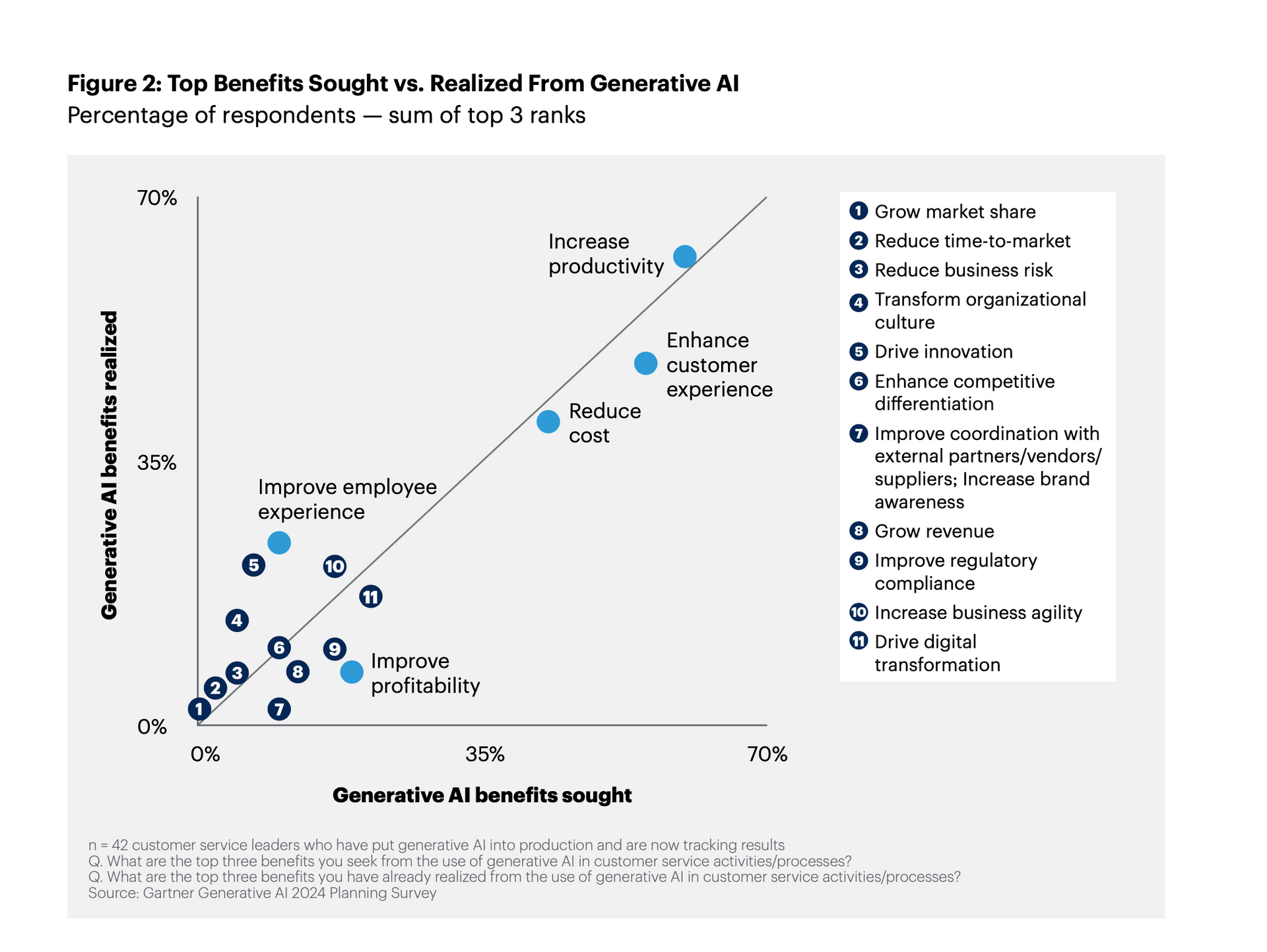
According to the Gartner report Revolutionize Customer Service with GenAI there is a major gap between what leaders expect from AI and what they actually get.


As shown in the chart above, while only 10% of customer service leaders initially sought out "improved employee experience" as a top benefit, a staggering 24% actually realized it after putting use cases into production.


This highlights that AI is not just an efficient play; it is a tool for eliminating value-eroding parts of a specialist's work. By focusing AI on internal-facing use cases first, we build the confidence needed to eventually scale to customer-facing solutions while directly tackling the burnout problem.


Incident investigation is one of the clearest places to start. Much of the 30% operational tax we talked about is paid here, in manual log analysis, where engineers spend hours scanning telemetry trying to reconstruct what happened. 


Agentic AI brings something closer to storytelling to this work: an agent correlates logs and infrastructure history to assemble a timeline in minutes, flagging whether a similar error appeared two weeks ago or whether there's a recurring fluctuation worth investigating.


The result is less time-to-detection, less investigation effort, and preserved cognitive energy, exactly the kind of relief that keeps senior engineers sharp through the rest of their shift instead of running on empty.

Support as a strategic powerhouse


When you give 30% of a senior engineer's time back, the entire department transforms. They move from being reactive ticket responders to becoming strategic technical leaders.

With the cognitive bandwidth saved by AI, senior talent can focus on more strategic tasks such as:


  • Mentoring junior and mid-level engineers to prevent future escalations.
  • Improving internal documentation so the AI has better data to learn from.
  • Fixing bugs in the core product at the source rather than just managing symptoms.


Protecting your senior talent requires more than a retention bonus. It requires an operational architecture that respects their mental energy.


By integrating AI as a technical companion, we ensure that our most experienced people are working on the problems that actually require their expertise.


I believe the best way to keep your elite technical assets is to remove the weight of the repetitive work that burns them out. 

You can explore how e-Core approaches it by looking into our AIOps solution, which is designed specifically to eliminate that operational overhead and keep your team's focus where it belongs.

Profile card for Ana Quaresma, Content Marketing Team, with a smiling portrait on a teal-accented background
Logo for e-core with an abstract figure and up arrow design, and "e-core" text. Blue and white colors.

e-Core

We combine global expertise with emerging technologies to help companies like yours create innovative digital products, modernize technology platforms, and improve efficiency in digital operations.

You may also be interested in:

By Ana Quaresma June 18, 2026
AI is no longer the differentiator — context is. Here's what four Atlassian ecosystem experts took from Team '26, and what it means for your team right now.
Neon AI agents icon network with glowing purple-blue lines and central “AI Agent” label on a dark background
By Ana Quaresma April 30, 2026
See how e-Core's AIOps solution helps IT teams prevent incidents, cut alert volume by 73%, and scale operations with governed, agent-driven automation.
Business meeting in a glass-walled office, with colleagues seated around a table and one person presenting.
By By the Tempo team April 9, 2026
In collaboration with Tempo, this article explores why rapid resource reallocation is now a competitive advantage, and how the most agile organizations turn planning into strategic impact.