

Vagas enhances algorithm for 5 million monthly recommendations using data analytics

e-Core • May 25, 2023

Vagas, a Brazilian company specializing in recruitment and selection technology that enables valuable matches between professionals and companies, has completed the first phase of its technological evolution to improve the user experience of its job and professional recommendation services. Before this, Vagas utilized separate matching engines with non-integrated algorithms. The company developed a unified mechanism called Single Matching Engine to address this issue. At the same time, Vagas is also migrating from the Google Cloud environment to the AWS cloud and is building a data lake on the Amazon platform to house applicant, job, and company information.

With the support of the e-Core and Solvimm (an e-Core company) teams, Vagas overcame four challenges in its technological evolution:

1. Data Ingestion from Data Lake AWS and Amazon OpenSearch Service

2. Data processing architecture (the data lake itself)

3. Processing the score in OpenSearch with the creation of APIs (Application Programming Interface) to process data and algorithms

4. Reducing costs with optimized infrastructure

Improved quality


By developing the Single Matching Engine, the Vagas team created a new, unified digital solution for recommending both companies to professionals and professionals to companies. Through this solution, Vagas achieved greater accuracy in hiring and offers, improving people management and results.


The Single Engine has two APIs: one to recommend applicants to companies and another to recommend companies to applicants. Vagas greatly simplified this process and remodeled it into an architecture that can be more scalable. A Data Lake architecture in the AWS cloud was the chosen solution, operating more accurately and using the matching resources on this platform.


The API for recommending applicants to businesses has been in use since October 2022. The development teams are now finalizing the API focused on applicants, which will go live in the last quarter of 2022.

“The APIs are extremely important for the Vagas business as we improve the quality of the information provided to companies looking for professionals and to applicants seeking opportunities in these organizations. Thus, we provide an effective two-way recommendation, which is well aligned with the core of our business.”


Samuel de Medeiros Queiroz

Head of Technology at Vagas

Consistent recommendations


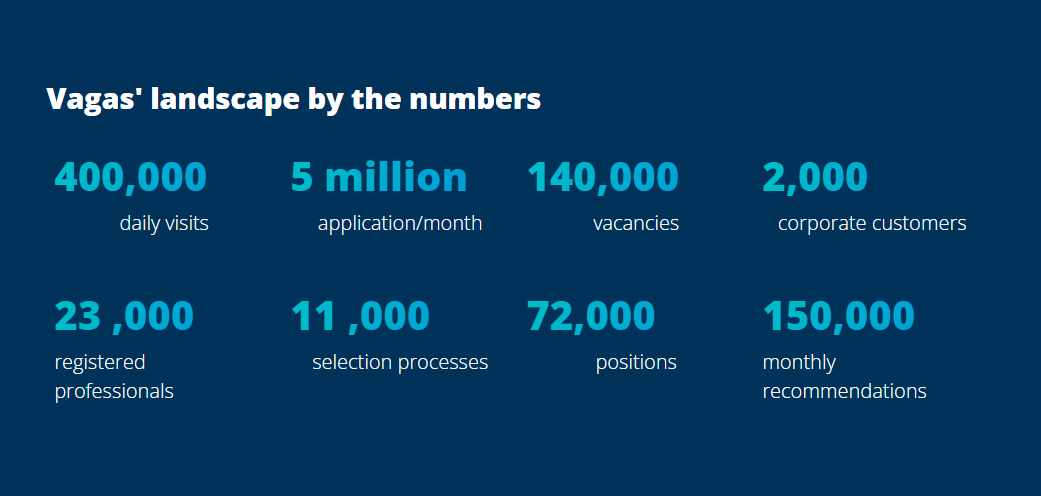
Vagas has more than 400,000 daily visits to its website and handles more than 5 million applications per month through Vagas.com. The company has generated more than 140,000 jobs in its recruitment and selection software in one year and has over 2,000 corporate customers and over 23 million registered professionals. By developing its new matching system, providing greater access and agility in employment processes, the company registered 11,000 selection processes per month, representing 72,000 positions, with an average of 300 applications per selection process and 150 million monthly job recommendations for professionals and recruiters.

“For companies and recruiters, we provide consistent recommendations of professionals. As soon as the selection process opens, our artificial intelligence immediately provides recommendations of professionals that fit the job.”


Samuel de Medeiros Queiroz

Head of Technology at Vagas

Furthermore, Queiroz informs that professionals now receive smart job recommendations by e-mail. Therefore, all recommendation services are connected to the Single Engine, which, as the name implies, is a unified site that will be completed with this second API by the end of this year.


The Vagas team is currently working with the support from e-Core in migrating to the AWS Data Lake for data management. In this centralized repository, Vagas can safely curate all its stored data – millions of vacancies and professionals –in their original form and prepared for analytics.


“We rely on the integration and data preparation skills of our strategic partner, e-Core, to move and consolidate data on the AWS platform,” says Queiroz.


Thus, with the Single Engine and the AWS Data Lake, Vagas will make further improvements in the information flow offered to customers, as well as in a new service called Collaborative Filtering. This solution optimizes another type of screening based on searched profiles, on opportunities that professionals are evaluating, and on the behavior of both professionals and companies while browsing the site, enabling Vagas to target even more the recommendation according to what both sides are seeking. Machine learning and artificial intelligence technologies are behind these and future improvements.


This is just the first step in the technological evolution Vagas is promoting in its services and platforms, focused on the ever-increasing quality of matching recommendations and on improving the customer experience.


e-Core

We combine global expertise with emerging technologies to help companies like yours create innovative digital products, modernize technology platforms, and improve efficiency in digital operations.


You may also be interested in:

Por Adriele Radmann 3 de agosto de 2026
Discover why customer support is your strongest shield against churn. Learn how to connect support, product dev, and AI to protect recurring revenue.

23 de julho de 2026
See how Banco Inter migrated to Jira Cloud, cut $200K in annual costs, and boosted team efficiency with e-Core as its implementation partner.

Por Flávia Batista 10 de julho de 2026
There is a belief that runs deep inside IT operations teams: a noisy environment is a healthy one. If alerts are firing constantly, if tickets are piling up, if the on-call rotation is getting hit at 2am, that means monitoring is working. The tools are catching things. I understand where this comes from. In the early days of observability, silence was genuinely suspicious. A quiet dashboard often meant a gap in coverage, a misconfigured rule, something important slipping through undetected. So teams learned to treat volume as proof, and that instinct stayed long after the environment around it changed. But noise is not proof that monitoring is working. In most cases, it is proof that something upstream was never fixed. Automation at the wrong end When alert volume becomes unsustainable, the response is almost always the same. Leadership looks at the backlog (a thousand tickets a day, engineers buried, SLAs slipping) and reaches for automation at the remediation end of the pipeline: AI agents plugged into monitoring tools, scripts that fire when incident X arrives, routing logic that moves tickets faster. These are reasonable responses to an unreasonable situation, but they treat cost rather than cause. Most of those alerts should never have been generated. Processing them faster does not change why they exist.