

GenAI “coaching” leads to 50% growth in customer engagement

e-Core • November 5, 2024

About the client


The client is the first fintech specialized in import solutions for businesses in Brazil and Latin America that offers financial solutions in credit, financing, and currency exchange, along with technology solutions that simplify, streamline, and unify services on a single platform. The company stands out through three fundamental pillars:


  • Technology: A team of programmers specialized in innovative solutions.
  • Financial Expertise: Financial knowledge to identify the best products and maximize results.
  • Import Focus: Founded in international trade with a long history in one of Brazil’s leading trading companies.


The challenge


The company operates through Sales Development Representatives (SDRs) who create business opportunities by contacting clients through various channels, including direct phone calls with leads. 


The business challenge was to extract quality metrics from these calls and ensure optimal use of the sales pitch, improving SDRs’ operational quality and increasing business opportunity conversion.


Previously, all call analysis to identify service improvement points, pitch adjustments, and service quality assessments were conducted manually by the manager, who would listen to each call’s audio and perform evaluations. To help generate automated reports for analyzing these calls, e-Core offered support with a custom artificial intelligence solution using AWS resources.


The solution


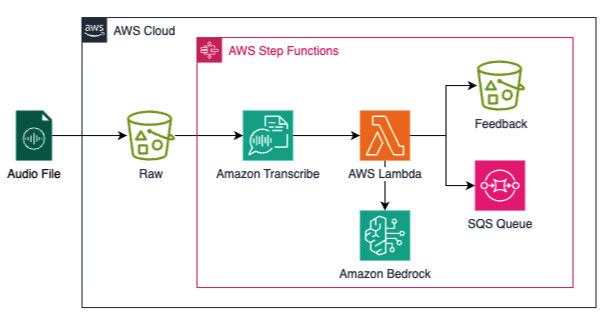
The solution begins by using the SDRs’ phone call recordings with leads. The first step was to create a processing pipeline to convert the recordings into text. With the transcribed audio, we used Generative AI to evaluate the call. We developed a prompt to assess the dialogue between the SDR and a lead, analyzing aspects such as pitch adherence, communication skills, and presentation of the company’s product and services.


The final analysis result provides constructive feedback focused on areas for improvement, development, and motivation for the SDR. We used a Generative AI model to automatically transform call transcriptions into structured data with Amazon Bedrock, extracting and organizing essential fields, and generating constructive feedback to improve SDR performance. The resulting file is stored in an AWS S3 bucket and sent to the manager’s area on the company platform via an AWS SQS queue. Below is the architecture of the custom solution developed by e-Core.

Diagram of an AWS cloud audio processing workflow using Step Functions, Transcribe, Lambda, Bedrock, and SQS.

The outcomes


The call analysis process, which previously required considerable time and effort from the manager, is now automated, enabling immediate feedback for both the SDR and manager right after each call. The solution’s scalability allows processing of 200 audios in just 2 minutes, something unachievable through manual efforts.


Additionally, the cost of the automated solution is lower than having someone perform the same task manually. Automation not only reduced the average call analysis time but also enabled detailed metrics for all calls, such as average call duration, call quality, and SDR productivity.


With feedback for all calls, the average call duration increased by 50%, indicating greater customer engagement, and call effectiveness improved by 20%. These results directly impact service quality and business opportunity conversion, solidifying the company as an innovative and efficient fintech in the import sector.


LET'S CONNECT

Ready to unlock your team's potential?


Logo for e-core in white text and blue graphic on a blue background. Graphic shows an upward arrow and person icon.

e-Core

We combine global expertise with emerging technologies to help companies like yours create innovative digital products, modernize technology platforms, and improve efficiency in digital operations.


You may also be interested in:

By Adriele Radmann August 3, 2026
Discover why customer support is your strongest shield against churn. Learn how to connect support, product dev, and AI to protect recurring revenue.
July 23, 2026
See how Banco Inter migrated to Jira Cloud, cut $200K in annual costs, and boosted team efficiency with e-Core as its implementation partner.

By Flávia Batista July 10, 2026
There is a belief that runs deep inside IT operations teams: a noisy environment is a healthy one. If alerts are firing constantly, if tickets are piling up, if the on-call rotation is getting hit at 2am, that means monitoring is working. The tools are catching things. I understand where this comes from. In the early days of observability, silence was genuinely suspicious. A quiet dashboard often meant a gap in coverage, a misconfigured rule, something important slipping through undetected. So teams learned to treat volume as proof, and that instinct stayed long after the environment around it changed. But noise is not proof that monitoring is working. In most cases, it is proof that something upstream was never fixed. Automation at the wrong end When alert volume becomes unsustainable, the response is almost always the same. Leadership looks at the backlog (a thousand tickets a day, engineers buried, SLAs slipping) and reaches for automation at the remediation end of the pipeline: AI agents plugged into monitoring tools, scripts that fire when incident X arrives, routing logic that moves tickets faster. These are reasonable responses to an unreasonable situation, but they treat cost rather than cause. Most of those alerts should never have been generated. Processing them faster does not change why they exist.